
What are tiny plankton?
Tiny plankton are a huge, diverse group of viruses, bacteria and eukaryotic single cells like protists and fungi living in surface, sunlit oceans. For this assessment we consider tiny cells as anything less than 20 micrometers (0.02mm). They carry out vital ecosystem functions like oxygen production, regulating nutrient cycling and are the base of the foodweb, supporting marine creatures and people alike.
What is the UK Marine Strategy Framework?
This is a part of UK environmental legislation that aims to measure and achieve Good Environmental Status every 6 years. There are 11 elements (or descriptors). In pelagic plankton systems, this includes the maintenance of sufficient biodiversity and food webs resources to sustain marine processes and foodwebs in a balanced way. But first, they need to be measured in order to be assessed.
Challenges
Tiny plankton are currently excluded from official UK marine assessments due to the lack of long-term datasets for tiny plankton. They are too difficult to count reliably by standard microscopy marine surveys. However, they can be detected and quantified into course, size-based groups by a technique called flow cytometry. Other methods are less accurate in counting cells of this size. However, it was not clear if such broad groups could respond consistently to human-influenced environmental pressures. This is important for their inclusion into the UK marine strategy health assessments. Increasing ocean temperature is considered a human pressure as it is a result of human activities that alter marine ecosystem conditions such as nutrient distribution. These have multiple consequences for plankton and impact marine ecosystem services like food web provisioning or maintenance of plankton biodiversity to regulate and sustain our seas.
As a research fellow at the Marine Biological Association, Rowena and UKPHEG colleagues carried out a study on newly matured flow cytometry datasets to find direct growth responses to these pressures. Rising ocean temperatures have an overriding impact on plankton cells, directly affecting their rate of growth. Surface ocean temperature warming can form separate warmer layers over cooler lower water layers especially in summer. This blocks nutrients from reaching plankton in surface waters.
Highlights
The study found that that tiny plankton represented more than 99% of plankton abundance and 71% of plankton biomass in one English Channel site (see diagram, left panel).
We found characteristics of these groups had useful and consistent physiological and seasonal growth traits, even though they are taxonomically broad.
Using a unique time-scale analysis technique the study showed the abundance of certain tiny plankton groups were significantly associated with ocean temperature and key nutrients (diagram, right panel).
These characteristics make them suitable as lifeforms (diagram, middle panel). Lifeforms are functional groups that act as biological indicators responding in a consistent fashion to human pressures.
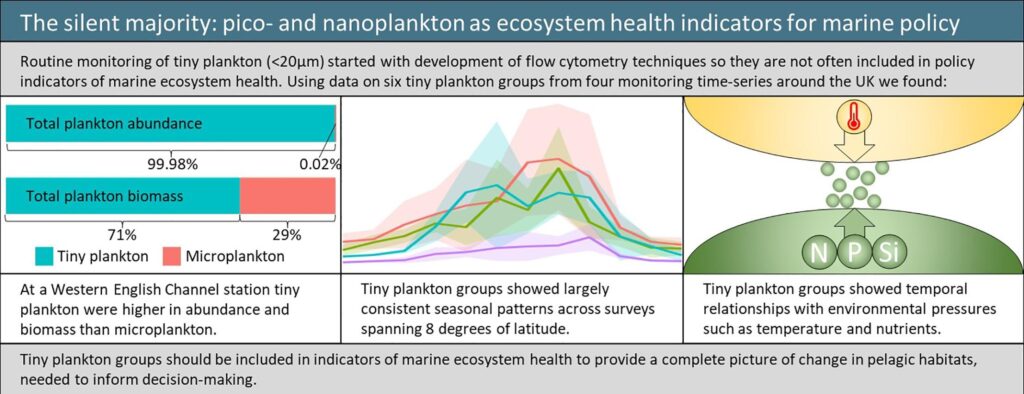
This summary figure, taken from published results of our study in McQuatters-Gollop et al. (2024), see link, illustrates tiny plankton growth responses to human pressures in UK seas
In the last year Tiny Ocean Health Insights have been working with the Environment Agency to progress the adoption of tiny plankton lifeforms for official UK Marine Strategy environmental assessments. We have advanced our understanding how their growth impacts ecosystem conditions and foodwebs, up to zooplankton trophic levels.
For further reading about work the UK Pelagic Habitat Expert Group are doing and plankton indicator development, see this blog:
https://marinescience.blog.gov.uk/2024/01/24/the-power-of-plankton-advancing-our-understanding-of-the-role-and-value-of-plankton-as-marine-natural-capital/
References
McQuatters-Gollop, A., Stern, R., Atkinson, A., Best, M., Bresnan, E., Creach, V., Devlin, M., Holland, M., Ostle, C., Schmidt, K., Sheppard, L., Tarran, G., Woodward, E., & Tett, P. (2024) ‘The silent majority: Pico- and nanoplankton as ecosystem health indicators for marine policy’, Ecological Indicators, 159. Available at: 10.1016/j.ecolind.2024.111650.